UNESCO CHAIR For Inter-Religious Dialogue Studies in The Islamic World
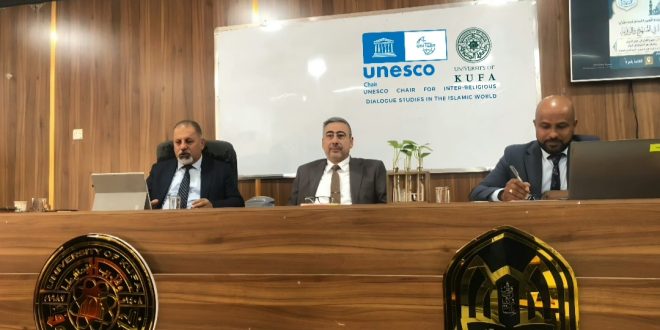
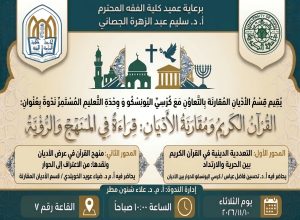
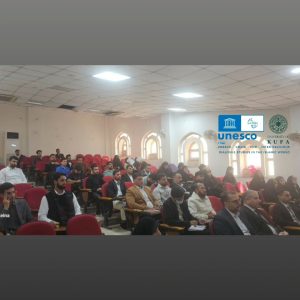
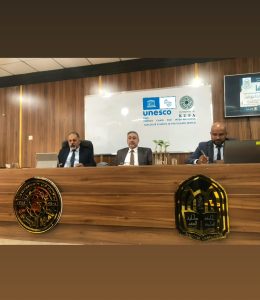
Dr. Tahseen Fadhil Abbas, a member of the UNESCO Chair for Interreligious Dialogue at the University of Kufa, participated in a scientific seminar organized by the Department of Religions at the College of Jurisprudence, entitled “The Holy Qur’an and Comparative Religion: A Reading of Methodology and Vision,” held on Tuesday, 10 November 2026.
In his research paper, Dr. Tahseen presented a Qur’anic perspective on religious pluralism, viewing it as an acknowledgment of the other and a rejection of individualism and conflict. In this regard, he cited the following Qur’anic verse: *“Had your Lord willed, He would have made mankind one community, but they will continue to differ”* (Qur’an 11:118).
He examined two approaches to religious pluralism: exclusivism, which confines truth and salvation to a single religion, an approach criticized by the Holy Qur’an; and inclusivism, which maintains that divine laws and religious traditions stem from a common origin and that sincere seekers of salvation may attain it.
Dr. Tahseen concluded by emphasizing that the Holy Qur’an established the principle of freedom of belief through the verse: *“There is no compulsion in religion”* (Qur’an 2:256). He further stressed that judgment concerning differences among religious laws belongs to God alone on the Day of Resurrection. Faith, he affirmed, cannot be imposed through coercion, but must be embraced through explanation and evidence. Ultimately, judgment on religious differences rests with God alone, fostering the values of tolerance and peaceful coexistence.