UNESCO CHAIR For Inter-Religious Dialogue Studies in The Islamic World
5th March, 2026
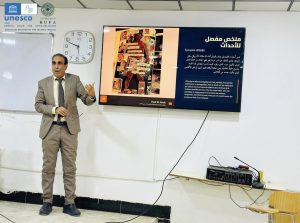
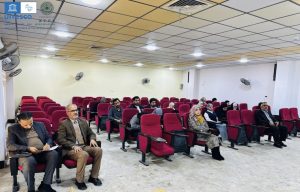
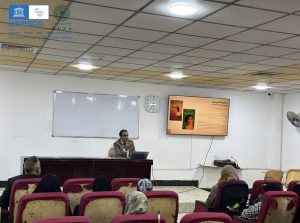
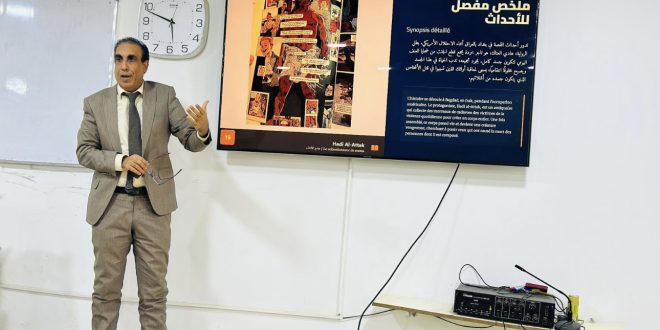
In collaboration with the College of Languages, the UNESCO Chair for Interreligious Dialogue convened a specialised academic symposium on Thursday, the 5th of March, 2026, hosted within the Department of French Language. The symposium was graced by a distinguished lecture delivered by Professor Dr. Alaa Shatnan, Director of the UNESCO Chair, under the title A Critical Reading of the “Novel of Violence” in Iraq — presented entirely in the French language before an audience comprising faculty members, students, and those deeply invested in literary and critical affairs.
Objectives of the Symposium
The symposium was conceived with a constellation of scholarly and cultural objectives, most prominent among them:
1. The Analysis of Literary Discourse: Exploring the manifold ways in which violence is represented within the Iraqi novelistic imagination in the aftermath of 2003.
2. The Fostering of Academic Dialogue: Casting light upon Iraqi literature as an “anthropological” corpus that faithfully documents the profound social and political transformations of an era.
3. The Building of Cultural Bridges: Presenting the Iraqi literary heritage through a world language — French — so as to fortify the presence of the Iraqi cause within the international critical landscape.
4. The Study of Identity: Examining the fraught problematics of belonging, diaspora, and divided loyalty that emerged as harrowing legacies of war, occupation, and terrorism.
Lecture Themes and Findings
Dr. Alaa Shatnan offered a penetrating critical reading of eight pivotal Iraqi novels spanning the years 2008 to 2017, demonstrating with considerable eloquence that the Iraqi novel has journeyed far beyond the mere “description of events” to arrive at nothing less than an “anatomy of existence.” Among the most salient findings he illuminated:
∙ The Body as Narrative Structure: In novels such as Frankenstein in Baghdad and The Dead of Baghdad, the shattered, dismembered body emerged as a potent symbol of national identity laid waste by the violence wrought through occupation and the forces of terrorism.
∙ The Dialectic of Place and Death: Baghdad, as rendered in such texts as The Baghdad Morgue, underwent a harrowing transformation — from a living space teeming with human vitality into a vast, sprawling mortuary, wherein the human self is stripped of its worth and reduced to a cipher, a number among numbers.
∙ The Conflict of Loyalties: A meditation upon the tragedy of the exile and the entrapped Iraqi, caught between the hammer of domestic tyranny before 2003 and the anvil of foreign occupation thereafter — as movingly portrayed in The American Granddaughter and The Kerosene Maqama.
Recommendations
At the conclusion of the extensive deliberations and discussions in which all those present participated with notable vigour, the symposium arrived at the following recommendations:
1. The Archiving of Modern Iraqi Literature: An urgent call to support studies that document “post-war literature” as an irreplaceable instrument of human and historical testimony — and, indeed, of moral indictment.
2. An Expansion of Translation Endeavours: A firm recommendation that these novelistic works be rendered into the world’s major languages — French foremost among them — so that the world may come to comprehend the magnitude of Iraqi sacrifice and the psychological metamorphoses endured by the Iraqi soul.
3. The Continuity of Specialised Symposia: A strengthening of the collaboration between the UNESCO Chair and the College of Languages, with a view to holding regular events that weave literature into the broader fabric of human values and civilisational dialogue.
4. The Development of Critical Methodologies: A summons to researchers to embrace “semiotic and anatomical” approaches in reading texts that grapple with profound collective trauma (Trauma).
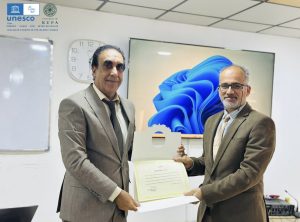
In closing, the participants expressed their warm appreciation for the wealth of knowledge so generously imparted by Dr. Alaa Shatnan. The Head of the Department of French Language honoured him with a certificate of distinction in recognition of his exceptional scholarly contributions and his singular role in animating the cultural life of the University.